

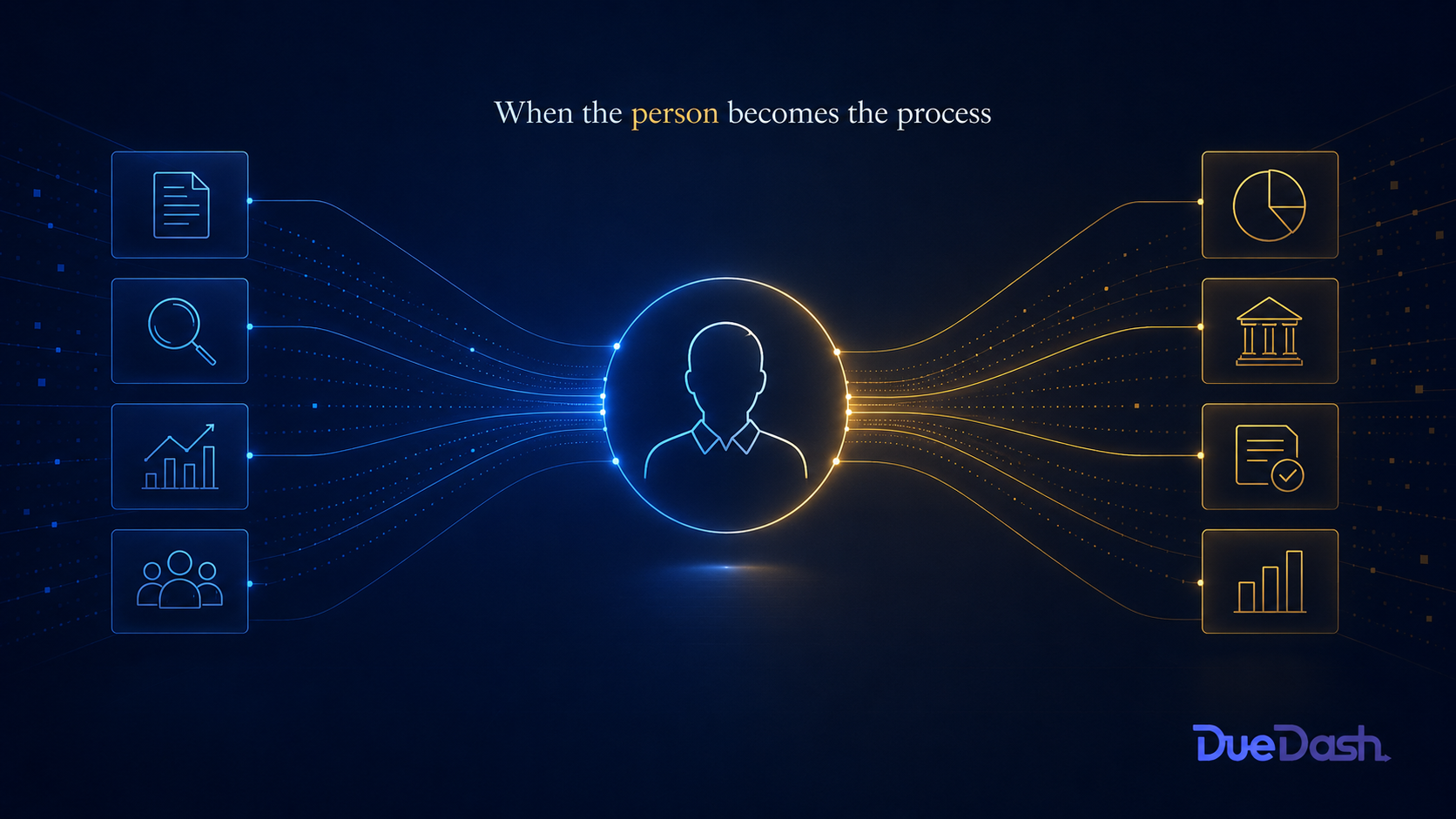
In many family offices, the investment process works perfectly well for years.
A principal builds the portfolio over time. They know intuitively which opportunities deserve a second look, which risks feel wrong, when the numbers do not tell the whole story, and when an exception is worth making.
The team learns how they think. Deals are analysed, questions are raised, and eventually the principal makes the call.
There is nothing obviously wrong with this arrangement until somebody else has to run it.
A succession begins. A new investment director joins. The next generation steps up. Or the principal simply decides they no longer want every significant decision to depend on them.
That is when the family office discovers that it has something extraordinarily valuable, a portfolio built over decades, and something far harder to transfer:
the implicit logic behind how those investment decisions were actually made.
The Distinction
A portfolio can be inherited.
An investment process has to be transferable.
The Process and the Person Can Become the Same Thing
This usually happens gradually.
Over time, the principal builds judgement from years of investing, working with founders, sitting on boards and seeing businesses succeed and fail.
They develop views about leverage, governance, valuation and people that may never be formally written down.
That judgement is valuable. It is often one of the reasons the investment programme works.
The difficulty comes when the organisation can no longer clearly separate the firm’s investment process from the way one person makes investment decisions.
While that person remains at the centre of the process, the distinction may not matter very much.
It matters when someone else has to take over.
A strong investment process should benefit from individual judgement. But another capable person should still be able to understand how the organisation invests without needing the original decision-maker in the room.
Succession Exposes More Than a Leadership Gap
Family office succession is usually discussed in terms of ownership, authority and who will make decisions next.
But there is another question underneath all of that:
What exactly is the next person inheriting?
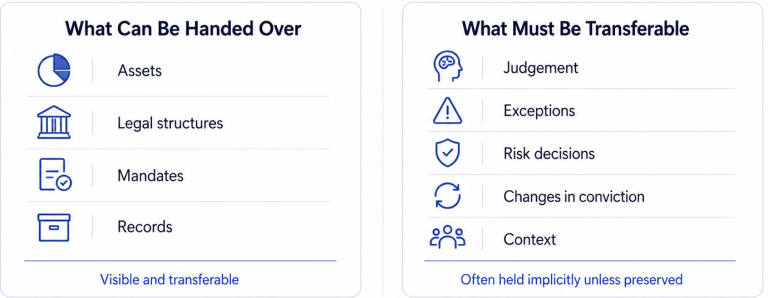
The assets are visible. The legal structures are documented. Investment mandates can be handed over.
What is much harder to transfer is the unwritten logic behind years of decisions.
A successor may be able to see which investments were made, but not always why one opportunity was pursued while another was rejected, why a particular risk was accepted, or what caused the principal to change their view during diligence.
The founder may know not only what sits in the portfolio, but why particular governance rights were negotiated, which risks almost stopped a deal, which exceptions were made and why certain opportunities were passed altogether.
Much of that knowledge may never have needed to be written down because the person carrying the context was always there to explain it.
Succession changes that assumption.
The next generation can inherit the portfolio without automatically inheriting the thinking that shaped it.
The Unwritten Rules Behind an Investment Process
Every experienced investor develops rules that are rarely written down as rules.
Some come from pattern recognition. Some come from mistakes. Others come from years of watching founders, boards, markets and capital structures behave differently from what the original plan suggested.
A principal may know that a particular governance issue matters more than the numbers imply. They may recognise when a forecast is technically credible but commercially unrealistic. They may be willing to accept one kind of risk while refusing another, even when both sit comfortably within the formal mandate.
None of this makes the investment process less rigorous.
In many cases, it is where much of the real judgement sits.
The problem is that these unwritten rules can become invisible to everyone except the person applying them.
A successor may inherit the investment policy, the portfolio and the formal decision record, but still struggle to understand how those principles were applied in practice.
The objective is not to turn experienced judgement into a checklist.
It is to make sure the important reasoning behind significant decisions is visible enough that someone else can understand it later.
That might include why a risk was accepted, why an exception was made, what changed during diligence, or why the firm walked away from an opportunity that appeared attractive on paper.
The more important the judgement, the more costly it is when only one person understands how it was applied.
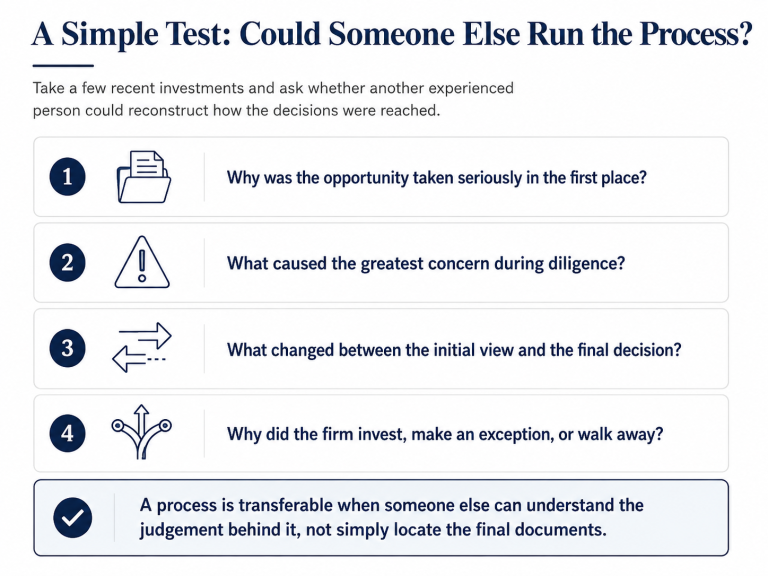
A Simple Test: Could Someone Else Run the Process?
A useful way to test this is to remove the original decision-maker from the picture.
Take a few recent investments and ask whether another experienced person in the firm could understand how those decisions were reached without having to call the principal who led them.
What Makes an Investment Process Transferable
I have seen this most clearly in investment processes that involve several people and stages.
In working with SecondMuse, for example, the investment programme moved through assessment, diligence, investor engagement and other review activity. Different people entered the process at different points.
What mattered was not simply that the final outputs were stored. It was that a later reviewer could understand what had happened earlier without having to find the person who had been there at the time.
The earlier review remained part of the record.
That is an important distinction because the natural response to succession risk is often to document more: longer investment policies, more detailed IC minutes, more handover notes.
Those things can help. But more documents do not automatically make an investment process transferable.
A successor still needs to understand the relationship between them. What evidence mattered? What was challenged? What changed the original view? Where did the organisation make an exception, and why?
That context is most useful when it is preserved as part of the investment process itself, while the reasoning is still current.
By the time succession becomes a formal project, years of that context may already be difficult to reconstruct.
A process becomes institutional when another capable person can enter it and understand how decisions were reached without having to reconstruct the history from individual memory.
What Family Offices Can Do Before Succession Begins
Succession is easier to prepare for before it becomes a formal project.
The objective is not to document every conversation or turn an experienced investor’s judgement into a manual. It is to identify the parts of the investment process that would be difficult for someone else to understand without the principal there to explain them.
Find Where the Process Still Depends on One Person
Start with the existing portfolio.
Which investments still require the principal to explain why a particular structure was chosen, why a risk was accepted or why the original thesis changed?
Those are the areas where the investment process remains most dependent on individual memory.
Preserve the Decisions That Need Explanation
Routine decisions rarely create the biggest continuity problem.
The useful context often sits around exceptions and changes: a concern that almost stopped a deal, a term that was renegotiated, an assumption that changed during diligence or an opportunity the firm chose not to pursue.
Those moments show how the investment philosophy is actually applied in practice.
Test Whether Someone Else Can Reconstruct the Decision
Ask an experienced colleague who was not involved in a transaction to review the institutional record.
Can they understand why the investment was made, what mattered during the review and how the final position was reached?
Where they need to go back to the original decision-maker for an explanation, you have found the part of the process that has not yet become transferable.
The best time to preserve that context is while the people who hold it are still there, not when succession has already begun.
Frequently Asked Questions
What is investment process continuity?
Investment process continuity is the ability for another capable person to understand and continue an investment process without depending entirely on the people who originally built it.
It means preserving enough of the reasoning and context behind significant decisions for someone else to understand how the organisation actually invests.
Why is this particularly important for family offices?
Family office portfolios often reflect years of accumulated judgement, relationships and family preferences.
During succession, the next generation or an incoming investment professional may inherit the assets without automatically inheriting all of the context that shaped them.
The challenge is therefore not only transferring the portfolio. It is making sure the thinking behind it remains understandable.
Is this the same as documenting an investment policy?
No. An investment policy describes the organisation’s mandate, objectives and boundaries.
Investment process continuity is about how those principles were actually applied when real decisions were made, including significant changes, exceptions and risk decisions.
Does this mean every investment discussion should be recorded?
No. The objective is not to preserve every conversation or disagreement.
It is to preserve the material reasoning another person would need to understand significant decisions, changes and exceptions.
Closing
A family office can spend decades building an investment capability around one person’s judgement.
There is nothing inherently wrong with that. Experienced judgement is often one of the most valuable things an investment organisation has.
The problem begins when the organisation assumes that capability will automatically transfer with the portfolio.
It will not.
A successor can inherit the assets, the mandates and the formal records and still struggle to understand how the organisation actually made investment decisions.
Judgement becomes institutional only when enough of the process around it can be understood by someone who was not there when it developed.
A succession-ready investment process is one that can survive the person who built it.
Over the years, I have seen organisations invest heavily in preserving documents, data and formal decisions.
The harder thing to preserve is context.
That matters because investment judgement does not end when a decision is made. It informs what happens next: follow-on capital, board decisions, exits, difficult conversations and sometimes the decision not to invest at all.
People will always carry part of that knowledge. That is unavoidable, and often valuable.
The risk begins when the institution has no other way to recover it.
The real test of institutional memory is not what the firm knows while everyone is still in the room. It is what the firm can still understand after they leave.
The DueDash Distinction
Traditional systems preserve the portfolio and its documents. DueDash preserves the Institutional Evidence around how significant investment decisions were reviewed, challenged and reached.
The objective is not to replace individual judgement. It is to make sure the investment process does not depend entirely on one person’s memory.
