
Governed review intelligence for high-stakes environments.
DueDash AI Studio adapts the DueDash evidence architecture to domain-specific review workflows, using AI-assisted review while preserving source attribution, human accountability, decision history, and institutional memory. AI can generate findings but Institutions still need evidence, human judgment, and memory to produce a truly goverend output.
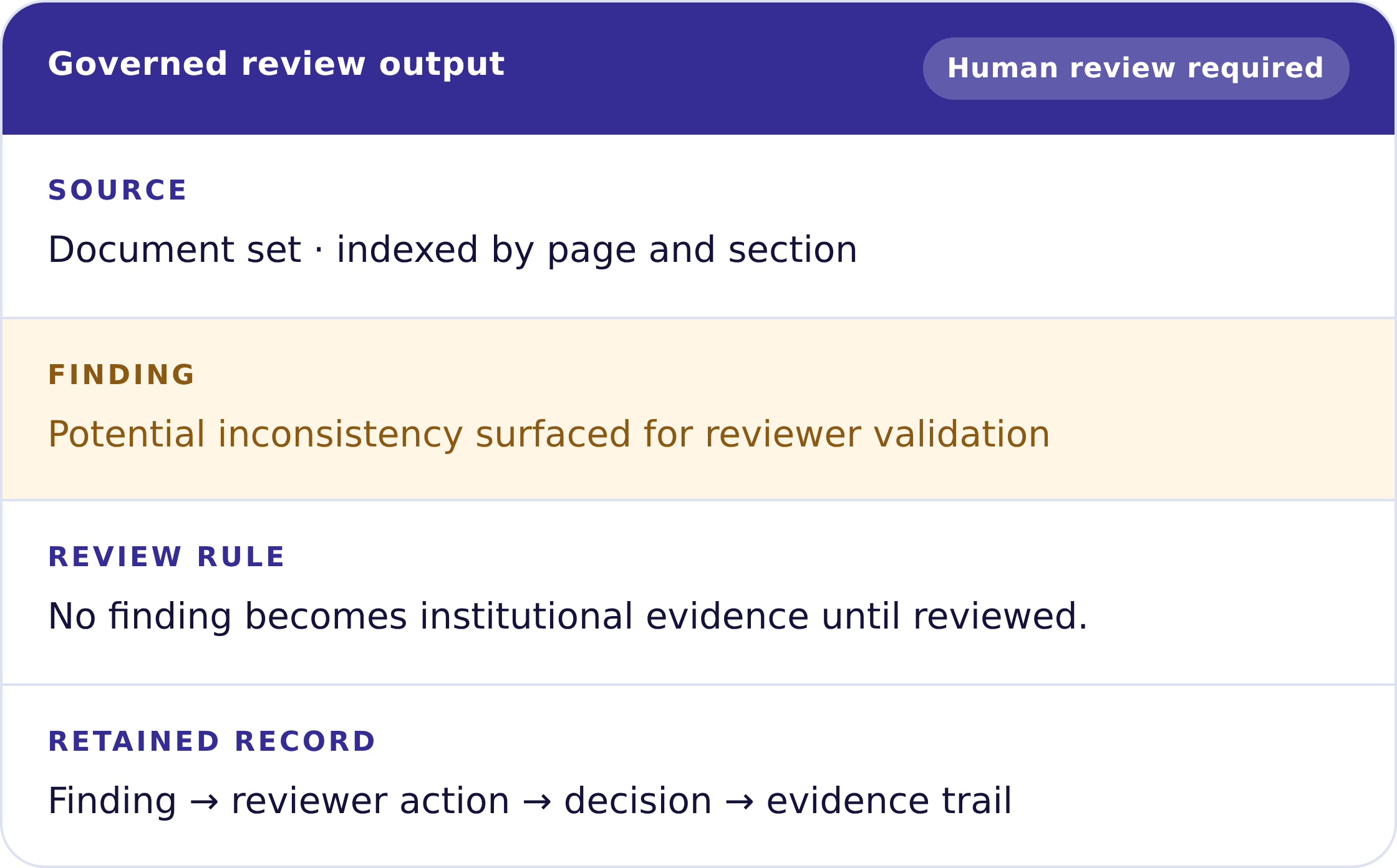
Why AI Studio
AI is not the workflow. Governed review is.
Individual AI tools can help people summarize, draft, and analyze faster. But high-stakes institutional work requires a governed review path: source attribution, reviewer validation, escalation history, decision context, and retained institutional memory. AI Studio exists to deploy AI into review environments without losing that evidence trail.
AI surfaces
Review intelligence identifies findings, inconsistencies, gaps, and risks across complex materials.
Human decide
Reviewers validate, escalate, approve, reject, or annotate findings with accountability.
DueDash preserves
The evidence trail, reviewer actions, and decision context are retained as institutional memory.
Proving Ground
Why private capital came first.
DueDash was developed in private capital workflows before expanding into legal, medical-legal, family office, and regulated review environments. Private capital created a useful proving ground because the work is document-heavy, time-sensitive, evidence-dependent, and often reconstructed later.

The same review-memory pattern appears across domains:
- Documents and discussions fragment across systems.
- Findings must remain linked to source evidence.
- Human judgment must remain accountable.
- Decision context must survive after the review ends.

The result is review intelligence designed for high-stakes institutional work, not consumer productivity.
The missing layer
Generic AI creates answers. DueDash preserves how review happened.
Generic AI tools
Individual output
- Generate summaries, drafts, and answers.
- Operate mostly at the individual level.
- May not retain reviewer actions.
- May not preserve decision lineage.
- Can separate outputs from institutional accountability.
DueDash AI Studio
Governed review
- Surfaces source-linked findings.
- Routes findings into human review.
- Preserves validation and escalation history.
- Retains decision context.
- Builds institutional memory over time.
DueDash does not replace individual AI tools. It preserves the institutional record around high-stakes work.
How the evidence layer works
One governed review, from intake to institutional memory.
DueDash is not a capability catalogue. It is a single evidence layer that governs how review happens from first document to retained record.
Ingest
Full document coverage across the data room, matter, or record set. Nothing left to sampling under deadline pressure.
Surface
Evidence inconsistencies and material findings surfaced, ranked by materiality, and attributed to source document and page.
Review
Findings routed to the right reviewer. Every validation, escalation, approval, and rejection is timestamped and reviewer-attributed.
Control
The governed record, sourced and traceable, that the next review builds on. Review history becomes institutional memory.
AI surfaces evidence. Humans make decisions. DueDash preserves the record.
Validation
Developed with high-accountability review environments.
Selected deployments, pilots, and design partners include:
Quake Capital
Design partner.
PalQ IP
Pilot.
Medical-legal deployment
Stealth mode.
One Architecture. New Domains.
The architecture adapts. The review-memory pattern does not.

DueDash was first developed in private capital, where document-heavy review, fragmented diligence, LP accountability, and decision reconstruction created the most demanding version of the institutional memory problem.
The same review-memory pattern later appeared in IP review, medico-legal review, legal disputes, regulated financial services, and other high-accountability environments. The source materials differ. The governance requirements differ. The need to preserve evidence, attribution, human decisions, and review history does not.
The DueDash evidence architecture remains consistent. The review environment, document types, workflow configuration, and deployment model adapt to the domain.
This is how a single evidence architecture can serve multiple review environments without becoming a different product for each one.
What compounds
The model is not the moat. The memory is.
Foundation models may become widely available. What becomes proprietary is the customer's retained evidence history, review logic, escalation patterns, human validation, and decision memory.
Review logic
How the institution applies criteria across matters.
Evidence patterns
What the institution repeatedly surfaces, flags, escalates, or rejects.
Human judgment
How accountable reviewers validate and decide.
Decision memory
What future teams can reconstruct and learn from.
Trust & Control
AI deployment should not weaken evidence control.
- Source-attributed findings
- Human reviewer validation
- Decision and escalation history retained
- Deployment aligned to customer requirements
- Generated output separated from institutional evidence
How the evidence layer works
One governed review, from intake to institutional memory.
DueDash is not a capability catalogue. It is a single evidence layer that governs how review happens from first document to retained record.
Most organizations already possess the knowledge required to make better decisions. The challenge is preserving how those decisions were reviewed, challenged, validated, and learned from. DueDash AI Studio helps transform review activity into institutional memory and institutional defensibility.
