
The architecture behind institutional memory.
DueDash connects review materials, AI-assisted findings, human actions, escalations, and decisions into a governed evidence record. It supports deployment models from isolated SaaS to dedicated environments for specific security, regulatory, or domain requirements. The evidence architecture stays consistent across domains; deployment adapts to each environment.
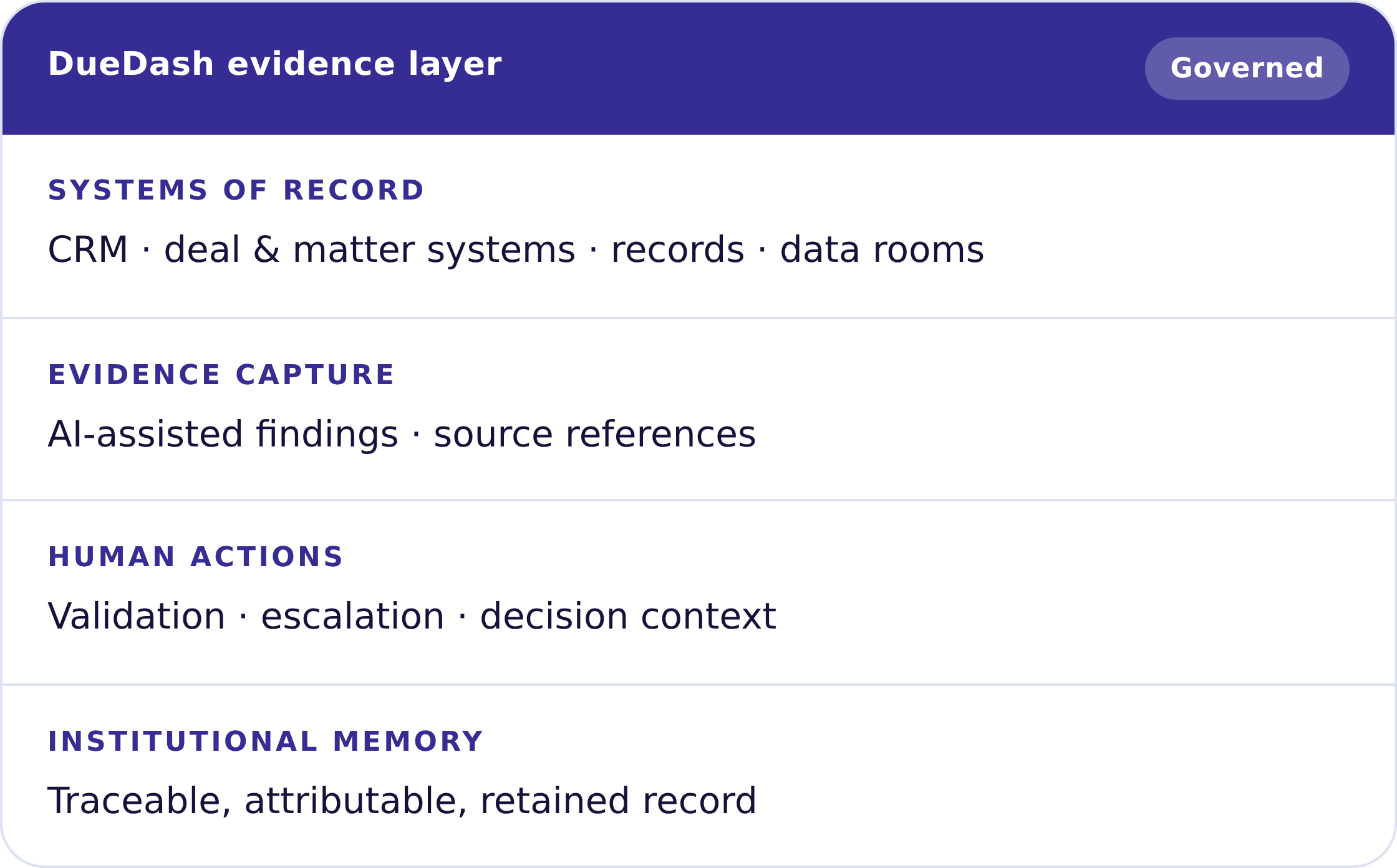
Where DueDash sits
The evidence layer between systems of record and systems of decision.
Layer
System of record
CRM, deal systems, matter systems, medical records, data rooms, compliance systems.
Source
Source materials
Documents, records, correspondence, diligence files, review files.
DueDash
DueDash evidence layer
AI-assisted review, source-linked findings, human attribution, escalation history.
People
Systems of decision
ICs, lawyers, reviewers, advisors, executives, compliance teams.
Memory
Institutional memory
Reconstructable evidence history, decision learning, defensibility defensibility.
DueDash does not replace systems of record. It preserves the review and decision trail across them.
One evidence architecture. Multiple review environments.
Why arhcitecture matters
Existing systems preserve fragments. DueDash preserves how decisions are made.
Without DueDash
The record is scattered.
- Documents live in one system.
- Discussions happen in another.
- AI outputs may remain in individual tools or chats.
- Decisions are captured in slides, meetings, or memory.
- Months later, the reasoning is difficult to reconstruct.
With DueDash
The record is connected.
- Source evidence remains linked to findings.
- Reviewer actions remain attributable.
- Escalations and decisions remain timestamped.
- Human judgment is preserved alongside AI-assisted review.
- Evidence memory compounds across workflows.
Core functions
What the infrastructure does.
Evidence capture
Preserves source-linked findings and review context.
Reviewer attribution
Records who reviewed, escalated, approved, or rejected findings.
Decision continuity
Maintains a reconstructable history of how understanding evolved.
Deployment allignment
Align deployment architecture to the operational, regulatory, security, and domain requirements of the environment.
Defensibility building
Transforms repeated review activity into defensible institutional memory.
Instiutional learning
Turns repeated review activity into searchable judgment, precedent, and decision memory.
How DueDash works
From workflow layer to decision-memory infrastructure.
First workflow
Evidence captured
The first review produces a source-linked evidence record.
Related workflows
Patterns emerge
Recurring findings and escalation patterns become visible.
Many workflows
Decision history becomes searchable
Decision history becomes searchable across the institution.
Institutional defensibility
Defensibility compounds
Instiutional defensibility compounds over time.
Most systems store what happened. DueDash preserves how the institution reviewed, escalated, decided, and learned.
Deployment models
Deployment aligned to the environment.
Different review environments require different operational models. DueDash supports deployment approaches ranging from logically isolated SaaS environments to dedicated deployments where customer, regulatory, domain, or security requirements justify them.
Logically isolated SaaS
For teams that need speed, structure, role-based access, encryption, and auditability without heavy infrastructure lift.
Dedidcated deployment
For customers with domain-specific, contractual, security, or regulatory requirements requiring greater operational separation.
Non-custodial deployment
For customers who require full ownership of their data, review history, and decision memory within their own environment.
Deployment architecture is aligned to customer requirements rather than forcing every customer into the same model.
Integration stance
Orchestrates. DueDash does not replace.
DueDash is not a CRM, data room, fund administrator, custodian, legal record-keeper, broker-dealer, investment adviser, transfer agent, or placement agent. It sits across workflows to preserve evidence, findings, reviewer actions, decision history, and institutional learning.
DueDash is not trying to become every system. It becomes the memory layer across the systems where high-stakes work already happens.
Walk one real workflow with our team and see where evidence, findings, and decisions can be preserved across your existing systems.
