

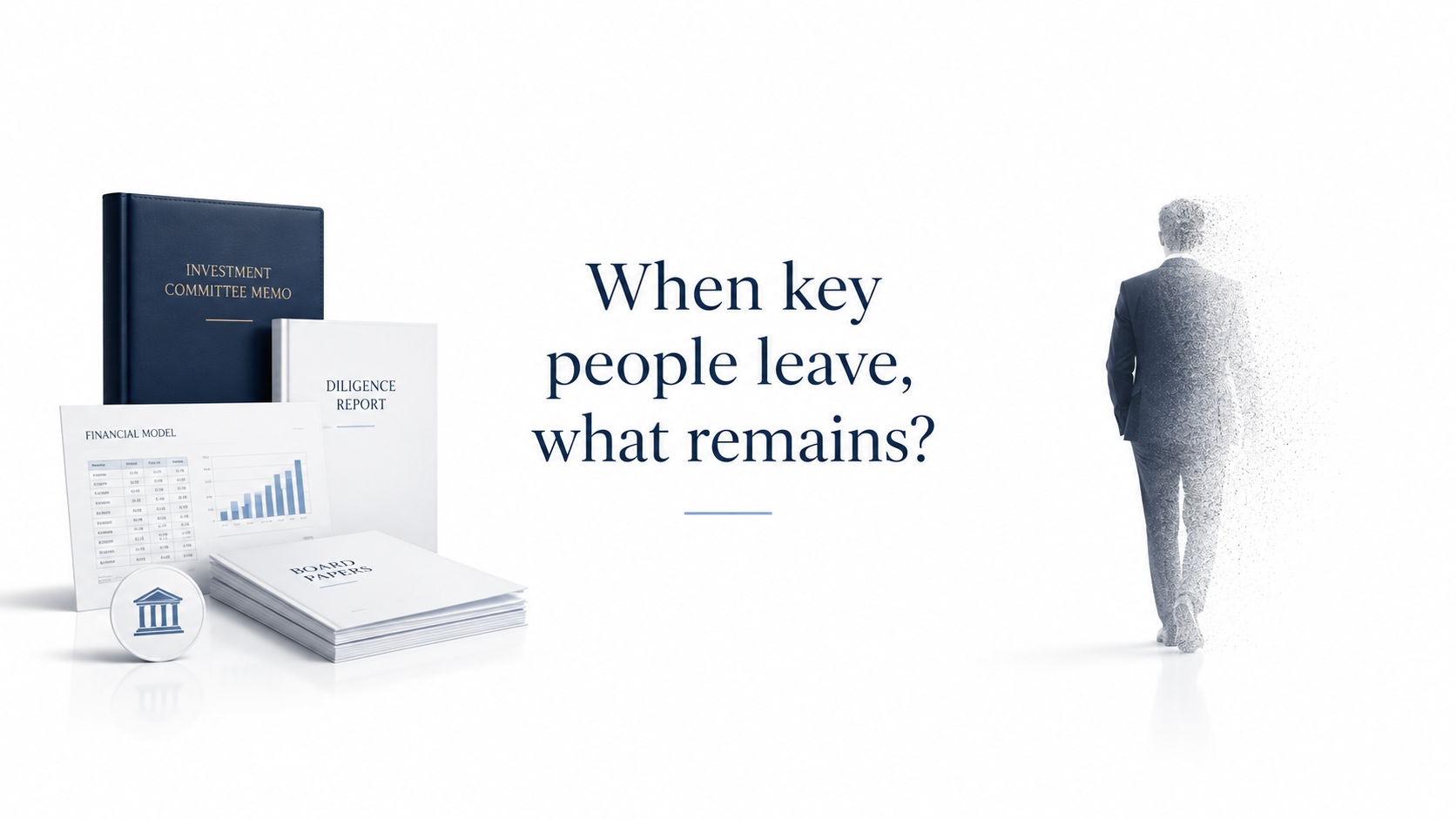
A senior investment professional leaves after years with a firm. A few months later, a new partner reviewing a follow-on investment asks why a particular risk was accepted three years earlier.
The IC memo is there. So are the model, the diligence reports, and the board papers.
What is harder to recover is what everyone involved understood at the time: what worried the committee, what changed during diligence, and why the team eventually became comfortable proceeding.
While the original people are still around, this gap is easy to miss. Someone recalls the discussion and fills in the context.
When they move on, that becomes much harder.
That is when a firm finds out how much of its institutional memory was actually held by a few people.
The Distinction
Institutional knowledge is what people in the firm know.
Institutional memory is what the firm can still understand when those people are no longer there to explain it.

What Is Institutional Memory?
Institutional memory is the firm’s ability to understand how important decisions were reached long after the original conversation has ended.
That means more than keeping the final memo or recording the vote. It means retaining enough context to understand what was considered, what changed, which concerns mattered, and why the firm ultimately took a particular position.
Private capital has traditionally relied on experienced people to carry much of that context forward. For a long time, that worked reasonably well.
But it also creates a dependency that is easy to overlook.
As long as the people stay, the memory appears to belong to the firm.
It is often only when someone leaves that the distinction becomes visible.
How the Dependency Builds
It rarely happens because someone designed the process badly.
It happens gradually.
An investment team documents the analysis. The IC memo is completed.
The financial model is stored. Diligence reports are retained.
Alongside those records, however, people carry something else: why one assumption was challenged more heavily than another, why a particular structure was chosen, what changed the team’s view, or why a risk was eventually accepted.
As long as the same people remain involved, both layers are available.
The documents provide the record. People fill in the context.
A departure, succession, difficult portfolio decision, or LP question changes that. Suddenly, the firm may need to reconstruct a decision without relying on the people who made it.
That is when institutional memory stops being an abstract governance issue and becomes an operating one.
What Actually Survives When Someone Leaves?
Not all institutional context is lost in the same way.
Some things are formally recorded. Some are shared across a team. And some sit almost entirely with the individual who lived through the decision.

The formal record usually survives.
What may not survive is the context between the documents: how the team interpreted the evidence, what they disagreed about, and why they ultimately made the choice they did.
That is the part a firm often has to reconstruct later.
A Simple Test for Institutional Memory
You do not need a complicated maturity model to see whether the problem exists.
Take a few important investments from the last three years and ask:
1. If the deal lead left tomorrow, what would become harder to explain?
2. Could another investment professional understand how the recommendation changed during diligence without speaking to the original team?
3. Could the firm explain why it passed on a serious opportunity, not just why it invested in the ones it chose?
4. If an LP or board member asked why a particular risk was accepted, could the answer come from the institutional record rather than someone’s memory?
If those answers depend heavily on finding the right person, the firm has an institutional memory dependency.
That does not mean the investment process is weak.
It means part of the process still lives with the people who experienced it rather than with the institution itself.
Key-Person Risk Is Also a Memory Risk
Private capital has always understood key-person risk.
When too much investment responsibility, relationship knowledge or decision-making authority sits with a small number of people, their departure matters.
But there is another part of that risk that receives less attention: what leaves with them intellectually.
The investment may be fully documented, yet important context can still depend on the people who were there when the decisions were made.
This became particularly visible to me in work with investment programmes involving multiple reviewers and stages.
At SecondMuse, for example, investment activity moved through deal assessment, diligence, investor engagement and other review stages involving different people. The useful part was not simply having the final outputs. It was being able to retain the record across those hand-offs rather than relying on one person to remember what had happened earlier.
That is a different way of thinking about continuity.
It is not only about whether a replacement can take over someone’s responsibilities.
It is whether they can understand the decisions they inherited.
The Problem Gets Harder as Firms Grow
This dependency tends to become more difficult to see as an investment organisation grows.
More people contribute to diligence. More specialists become involved. More conversations take place across different systems. Responsibility for a decision becomes distributed across a larger group.
That can improve the investment process.
But it also means that the context behind a decision is spread across more people and more places.
AI adds to this rather than changing the underlying problem. Teams can now examine more information and surface more findings before a decision is made. Human judgement still determines what matters, what gets challenged and what ultimately influences the recommendation.
The question is whether that judgement stays accessible after the people involved move on.
This is why I would not respond by asking investment teams to write longer memos or create more documentation.
The better approach is to preserve the important context while the work is happening: what changed, what was challenged, what mattered and why the team reached the position it did.
It should not require someone, two years later, to reconstruct the story from emails, old files and memory.
Institutional memory works best when it is built during the decision, not recreated after it.
What Firms Can Do Now
The answer is not to document everything.
It is to be more deliberate about the context that would be difficult to replace.
Know where the dependency sits
Look across the active portfolio and ask a simple question: who could explain the history behind this investment if we needed it tomorrow?
If the answer is one or two people, that is useful to know.
The objective is not to remove their judgement from the process. It is to make sure the institution is not entirely dependent on their memory.
Preserve the reasoning, not just the output
IC memos, diligence reports and financial models all matter.
But some of the most useful context sits between them: what changed the team’s view, which concerns mattered, why a risk was accepted, or why one course of action was chosen over another.
That is the context worth keeping.
Do it while the context is still fresh
Once people have left, reconstruction becomes much harder.
Emails can be searched. Old files can be reopened. Former colleagues can sometimes be called.
But none of those is a substitute for preserving the important reasoning when the decision is actually being made.
Institutional memory is much easier to preserve than to rebuild.
Over the years, I have seen organisations invest heavily in preserving documents, data and formal decisions.
The harder thing to preserve is context.
That matters because investment judgement does not end when a decision is made. It informs what happens next: follow-on capital, board decisions, exits, difficult conversations and sometimes the decision not to invest at all.
People will always carry part of that knowledge. That is unavoidable, and often valuable.
The risk begins when the institution has no other way to recover it.
The real test of institutional memory is not what the firm knows while everyone is still in the room. It is what the firm can still understand after they leave.
Frequently Asked Questions
What is institutional memory in private equity?
Institutional memory is the firm’s ability to reconstruct how important investment decisions were reached, even when the people involved are no longer there to explain them.
It includes more than the final decision. It includes enough of the reasoning and context to understand how the firm reached that position.
How is institutional memory related to key-person risk?
Key-person risk is usually discussed in terms of leadership, investment responsibility, and relationships.
There is also a knowledge dimension.
If important investment context exists primarily in the memory of a few people, their departure can leave the firm with the formal record but without the full reasoning behind it.
Why does institutional memory matter to family offices?
Family offices often hold investments across long periods and across generations.
When leadership changes or external professionals join, the next team may inherit the portfolio without inheriting all of the context behind it.
Preserving that context makes it easier to understand not only what the family invested in, but why.
What happens when a senior investment professional leaves?
The documents usually remain.
What may be harder to recover is the context around them: which concerns mattered, what changed during the review, how relationships influenced the situation, and why certain risks were ultimately accepted.
The extent of that loss depends on how much of the reasoning was preserved while the person was still there.
The DueDash Distinction
Traditional systems preserve documents. DueDash preserves the Institutional Evidence around the decisions they support: what was reviewed, what changed, what was challenged, and why the institution reached the position it did.
The objective isn't more documentation. It's making sure institutional memory stays with the firm, not only with the people who were there.
