

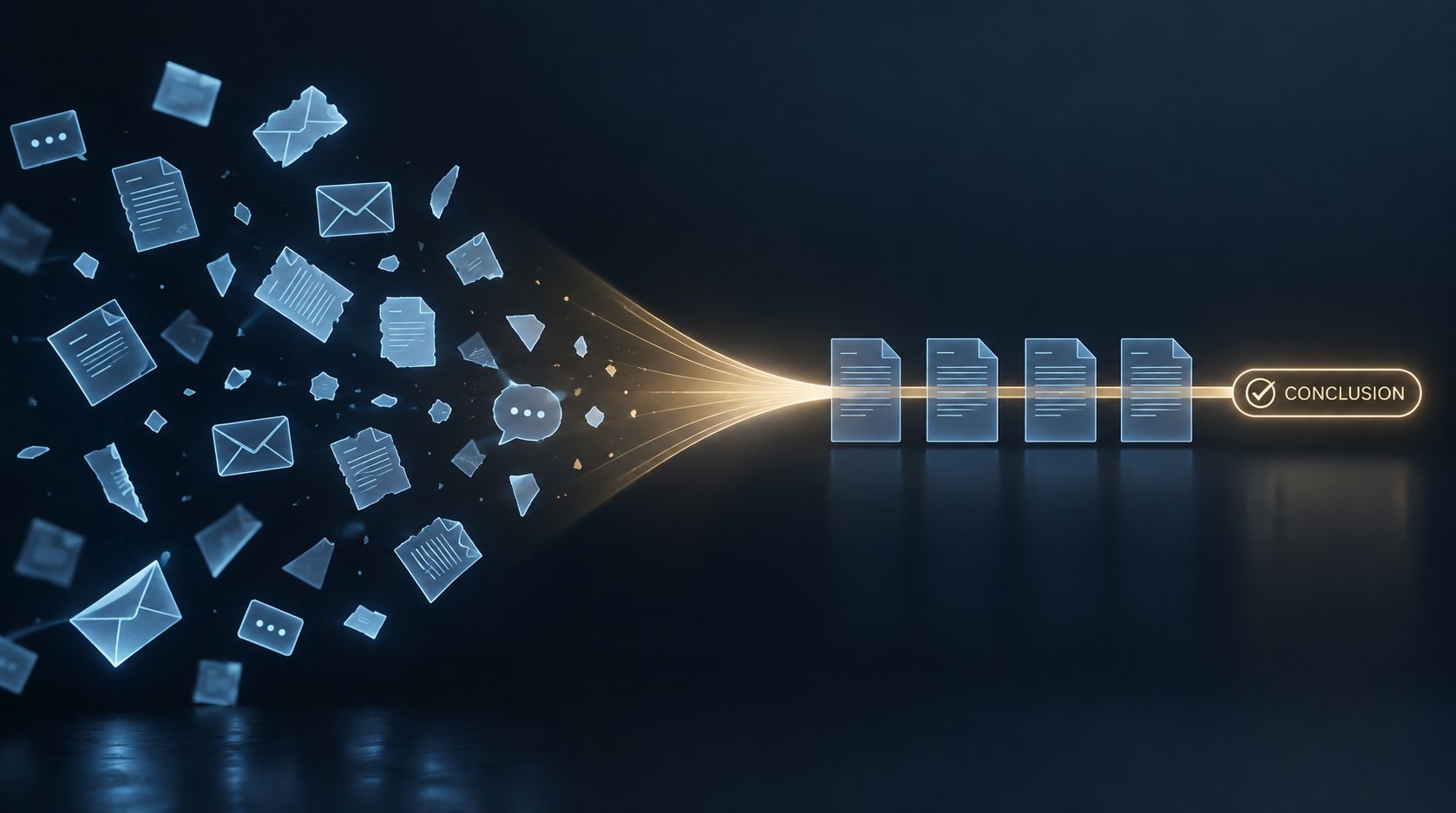
A large investigation rarely suffers because nobody found the document.
More often, different people find different pieces of the story.
One reviewer flags a transaction. Another finds an email that changes its meaning. A subject matter expert adds context on a call. Counsel revises the position in a later draft.
None of that information is necessarily missing.
But it may now sit across a document repository, email threads, meeting notes, AI summaries, and different versions of the analysis.
Each person can understand the part they worked on.
What becomes harder is seeing how those pieces came together.
The institution may have all the evidence and still lack a coherent record of how that evidence became a conclusion.
The Distinction
Evidence collection tells you what the institution has.
Review continuity tells you what the institution did with it.
What Fragmented Review Actually Looks Like
Fragmented review rarely starts with a bad process.
It usually starts with normal work happening in different places.
One reviewer flags something in a document. Another adds context over email. A subject matter expert raises a concern in a call. An AI tool produces a summary. Counsel revises the interpretation after seeing additional evidence.
Each step may be completely reasonable.
The difficulty is that the steps do not always remain connected.
The source document sits in the repository. The summary may sit somewhere else. Comments live in a draft. Discussion happens in email or meetings. The final position appears later in a memo or report.
While the matter is active, the team can often bridge those gaps from memory.
What becomes difficult later is reconstructing how one finding moved through the review and eventually affected the institution’s position.
That is where fragmentation becomes visible.
The problem is not that the evidence disappeared. It is that the path from evidence to judgement became difficult to follow.
Where the Review Breaks Apart
The break usually happens between stages, not within them.
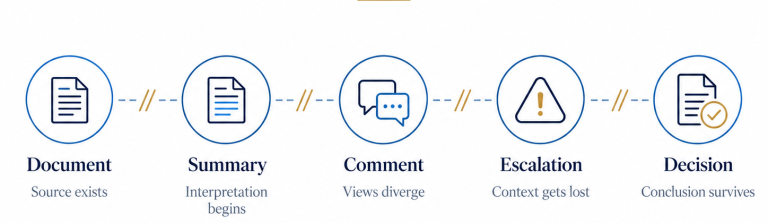
A document is reviewed. A finding is noted. Someone adds context. Another reviewer challenges the interpretation. The issue is escalated, revised or dismissed. Eventually, a position is reached.
Each step may be recorded somewhere.
What is often missing is the connection between them.
The source document may sit in the repository, the reviewer’s comment in another system, the discussion in email, and the final conclusion in a memo. By the end of the matter, the institution has preserved the individual pieces but not necessarily the path that connected them.
That becomes especially important when a finding changes over time. Something that initially looked insignificant may become material after another document appears. A concern may be escalated and later resolved. A reviewer may change their interpretation after speaking with a subject matter expert.
If those changes are not connected as the review develops, the final record can look much more straightforward than the work that produced it.
The fragmentation happens in the hand-offs: from document to finding, finding to discussion, discussion to escalation, and escalation to decision.
A Simple Test: Can You Reconstruct One Finding?
Take one material finding from a recent review and see whether the institutional record can tell you what happened to it.
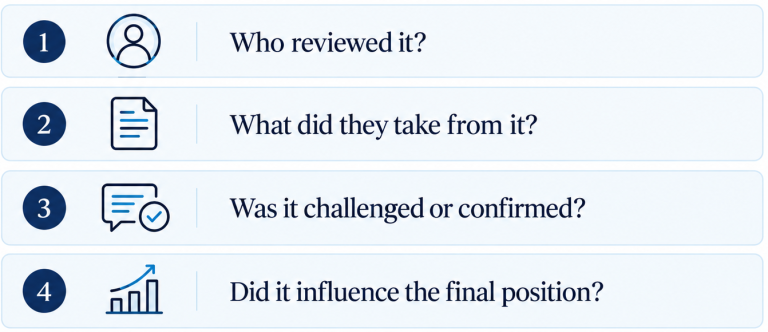
If the answers depend on finding the people who remember what happened, the evidence may still be intact, but the review around it is not.
Why AI Makes the Existing Problem Bigger
AI did not create fragmented reviews.
Legal and investigation teams were already working across repositories, emails, drafts, meetings, and individual memory long before AI became part of the process.
What AI changes is the volume and speed.
A team can now summarise more documents, surface more potential issues and compare more information in less time. That is useful. But it also creates more findings that someone has to interpret, challenge, dismiss or escalate.
The important question is not whether an AI tool produced a summary or flagged an anomaly. It is what happened after that.
A reviewer may agree with the finding, challenge it, check it against the source material, or change their view when additional evidence appears. Some findings will influence the final position. Many will not.
If those decisions happen across different tools and people without remaining connected, faster review can create a larger reconstruction problem later.
AI increases how much a team can review. It does not automatically preserve how that review was understood.
What I Have Seen in Practice
I have seen this problem most clearly in medico-legal review, where the documents are rarely the issue.
In one review workflow, the clinical team had already worked through the underlying records. The material was available and had been reviewed.
When the same records were examined again through a more structured review process, approximately $12,400 in billing discrepancies surfaced from documents that were already in the corpus.
The interesting point was not that somebody had failed to collect the evidence.
The evidence had been there all along.
What had been difficult to preserve was the connection between individual findings, how they had been interpreted, and whether they had ever become part of the institutional view.
That experience reinforced something I have seen in other complex reviews as well:
Having reviewed a document is not the same as being able to reconstruct what the review discovered.
The more people, documents, and systems involved, the more important those connections become.
What Legal and Investigation Teams Can Do Now
The answer is not to create a separate administrative record after every review.
It is to preserve the important connections while the work is happening.
Keep Findings Connected to Their Source
A material finding should remain linked to the document, data, or evidence that produced it.
That sounds obvious, but the connection becomes surprisingly easy to lose once findings move into summaries, emails, and later drafts.
Preserve What Changed
The most useful part of the review record is often not the first interpretation.
It is what happened afterwards.
Was a finding challenged? Did another document change its meaning? Was it escalated, narrowed, or dismissed?
Those changes explain how the team moved from evidence to a position.
Test Whether the Review Can Stand Without the Reviewers
Take one active matter and choose a material issue.
Could someone who was not part of the original review understand what was found, who considered it, how the interpretation changed, and where the issue ultimately landed?
If the answer depends on reconstructing email threads or finding the person who remembers the discussion, that is where the review is still fragmented.
The best time to preserve review continuity is while the review is happening, not when someone later asks you to reconstruct it.
Frequently Asked Questions
What is review continuity in legal and investigation work?
Review continuity is the ability to reconstruct how a material finding moved through a review: who saw it, what they concluded, what changed, and how it affected the final position.
It is different from simply having access to the underlying documents.
How is fragmented review different from missing evidence?
Missing evidence means the organisation does not have the relevant material.
Fragmented review means the material exists, but the history of how it was interpreted, challenged and connected to the conclusion is difficult to reconstruct.
Does review continuity require recording every discussion?
No. The objective is not to preserve every conversation, comment, or draft.
It is to retain enough of the material review history for another person to understand how an important finding developed and why it ultimately mattered, or did not.
How does AI affect review continuity?
AI can increase the volume and speed of review, but it does not automatically preserve what happened after an output was generated.
If AI-assisted findings influence a legal or investigative position, the important question is whether the institution can later understand how those findings were reviewed, challenged, and used.
Complex reviews can involve thousands of documents, several reviewers and, increasingly, AI-assisted analysis.
But the institutional risk often appears in a much smaller place: the missing connection between what was found and what happened next.
Evidence alone does not explain a conclusion. Someone may need to understand which findings mattered, how they were interpreted, what was challenged, and why the institution ultimately reached the position it did.
That becomes especially important when the original review team is no longer together or when the matter has to be revisited months or years later.
The objective is not to preserve every comment or conversation.
It is to make sure the important reasoning does not disappear once the review is over.
A strong review record does more than preserve the evidence. It preserves how the institution understood it.
The DueDash Distinction
Traditional systems preserve documents and final outputs. DueDash preserves the Institutional Evidence around the review: what was reviewed, who reviewed it, what changed, what was challenged, and how material findings shaped the final position.
The objective isn’t more review documentation. It’s making sure the path from evidence to judgement remains reconstructable after the review is over.
