

The meeting is a Fund II first close.
The GP is prepared. The track record is strong. The investment thesis is clear. Every expected question has been anticipated.
The institutional LP reviews the materials, looks up, and asks:
‘Before we go further, can you walk us through your review process on Deal X from Fund I? Not the outcome, the review itself. Who reviewed it? What changed during diligence? How did those discussions shape the final decision?’
The answer exists but not in one place.
Part of it sits in email threads. Some lives in analyst notes. Some is buried in a shared drive. The rest depends on the memory of a principal who joined after the deal closed.
Reconstructing that review process from documented records, while the LP is sitting across the table, isn’t something most firms are prepared to do.
This is the LP question.
It isn’t new.
But it’s becoming an increasingly common part of institutional due diligence.
The Distinction
Track record proves the outcome. Process accountability proves how it was achieved.
LPs aren’t replacing 'What did you invest in?' with 'How did you review it?' they now demand both.
Performance opens the door. Process closes the check.
What LPs Are Actually Asking For
The question isn’t whether the investment process was rigorous.
It’s whether that rigour can be demonstrated.
That’s the distinction many emerging managers miss.
A strong track record tells an LP what decisions your team made. Increasingly, institutional LPs also want confidence that those decisions came from a repeatable, well-governed investment process.
For Fund I, historical performance often carries most of the discussion.
By Fund II, particularly with institutional allocators, endowments, and fund-of-funds, the conversation increasingly expands beyond performance. LPs begin asking how investment decisions were reached, how the process was governed, and whether that process can be demonstrated from documented records.
That is what I refer to as LP process accountability.
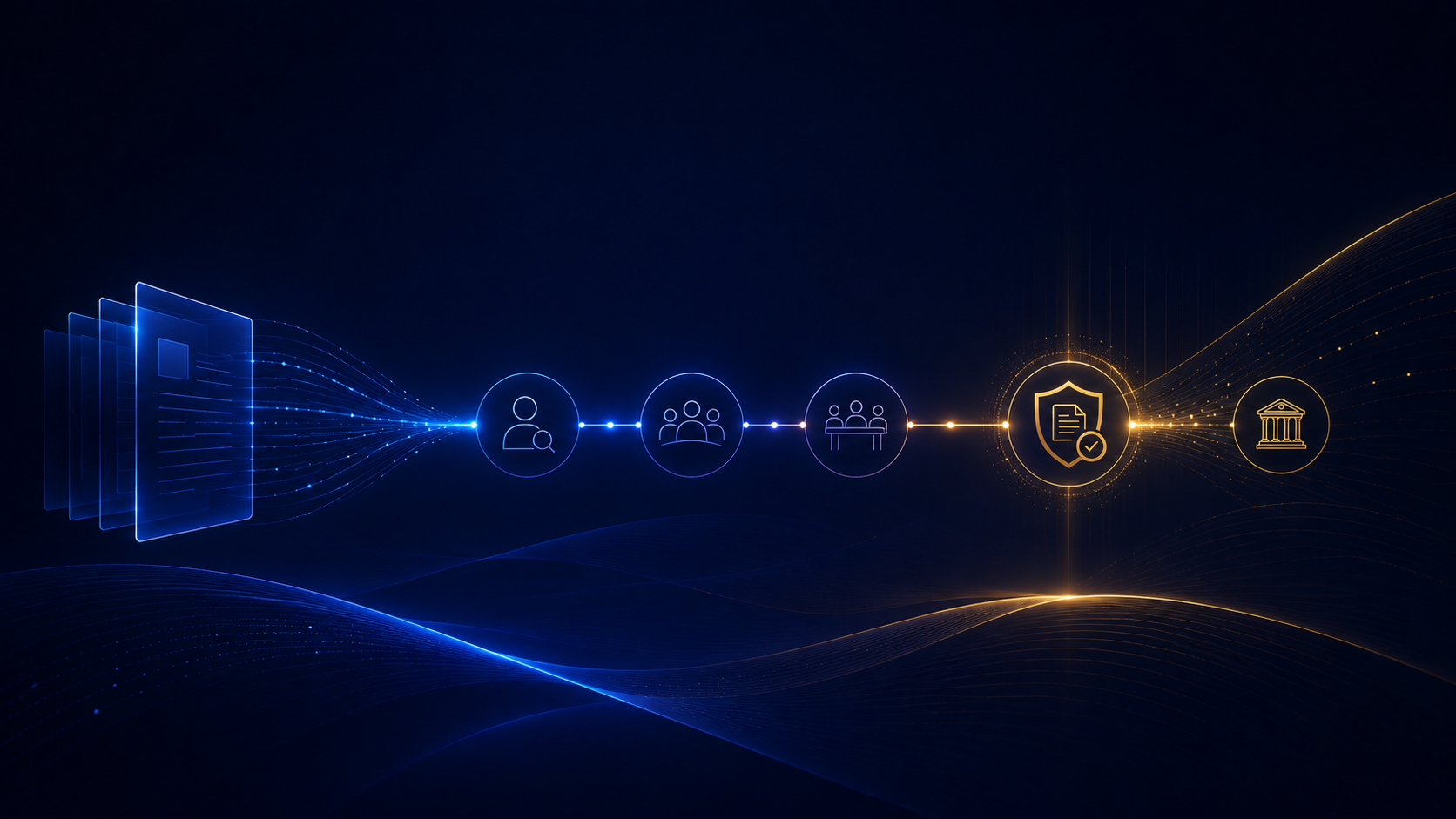
It is the documented, reconstructable record of how an investment team reviewed an opportunity: which materials were reviewed, by whom, how findings evolved, what concerns were escalated, what the investment committee considered, and how the final decision was reached.
Track record explains what happened.LP process accountability explains how it happened. Institutional LPs increasingly expect both.
The Growing Evidence Gap
For decades, LP diligence focused primarily on investment outcomes—the thesis, the portfolio, and the returns.
That hasn’t changed. What has changed is the expectation that investment firms can also demonstrate how those outcomes were reached.
As institutional allocators increase the depth of operational due diligence and as AI becomes part of investment workflows the conversation increasingly includes questions such as:
- How was the investment process governed?
- Can the review process be reconstructed from documented records?
- How is AI-assisted analysis reviewed before decisions are made?
These questions are exposing a gap that many emerging managers haven’t formally recognised.
It isn’t a gap in investment capability. It is a gap between what the firm knows internally and what it can demonstrate externally.
Most emerging managers conduct disciplined diligence. Far fewer have infrastructure that preserves a complete review record as the work happens.
When an LP asks to see that process months or years later, many firms find themselves reconstructing it from emails, meeting notes, shared drives, and institutional memory rather than producing it directly.
That’s the accountability gap.

The LP Readiness Assessment: Five Diagnostic Questions
Run these questions against your three most recent investments before your next LP meeting. They reflect the types of questions institutional allocators increasingly ask during structured operational due diligence.
1. Reconstructability
Can you reconstruct the full review process for your three most recent investments using documented records alone without relying on partner or analyst memory?
2. Responsiveness
If your anchor LP asked to review the diligence behind your most recent investment today, how quickly could you produce it and what would it include?
3. Source Attribution
Can you identify exactly which source documents informed your most recent Investment Committee (IC) recommendation?
4. AI Oversight
Can you demonstrate, from documented records, who reviewed and validated AI-assisted analysis before it informed an investment decision?
5. Key-Person Risk
If your most experienced investment professional left the firm tomorrow, how much of your investment process would leave with them?
If answering any of these questions depends on emails, meeting notes, or individual recollection rather than documented records, you’ve identified your LP accountability gap.
The accountability conversation has already started. The firms prepared for it will be the ones that can demonstrate their process—not just describe it.
What the Evidence Shows
The shift toward greater process accountability isn’t theoretical. It’s visible across both institutional LP expectations and the increasing adoption of AI within investment workflows.
The ILPA Emerging Manager Initiative has consistently highlighted operational infrastructure, including investment process documentation, as an important indicator of institutional readiness during LP due diligence. As funds mature and institutional capital increases, expectations around governance become more rigorous.
At the same time, AI adoption is accelerating faster than the governance practices surrounding it. Thomson Reuters’ research shows rapid growth in AI adoption across professional services, while documented governance frameworks continue to lag. For investment managers, the implication is straightforward: AI-assisted diligence is expanding faster than the infrastructure required to demonstrate how that diligence was governed.
Why AI Raises the Bar
AI allows investment teams to review more opportunities, analyse more information, and move through diligence faster than ever before.
But every additional AI-assisted review creates another decision process that institutions may later need to explain.
A firm reviewing fifteen opportunities with AI isn’t just producing more analysis than a firm reviewing five manually. It’s also creating substantially more governance activity that may need to be demonstrated during LP due diligence.
Without infrastructure that scales alongside AI adoption, governance doesn’t become simpler; it becomes harder to demonstrate.
The firms responding most effectively aren’t using less AI. They’re ensuring that every AI-assisted review leaves behind a documented record of how human judgement shaped the final investment decision.
What Leading Organisations Are Building
Leading organisations are responding to this shift by treating process defensibility as part of their operating model rather than a compliance exercise.
Instead of relying on teams to reconstruct review history after an audit, regulatory inquiry, or legal challenge, they are embedding evidence capture directly into AI-assisted workflows. As decisions are reviewed, the review itself becomes part of the institutional record.
In practice, this means preserving a documented record of who reviewed the AI-generated analysis, what changed during that review, why those changes were made, and how they influenced the final decision.
The objective is not more documentation. It is ensuring that governance produces evidence as a natural by-product of decision-making.
Building Institutional Readiness
The emerging managers preparing most effectively for institutional capital are not producing longer investment memos. They are building the operational layer beneath them.
That layer preserves four things across every investment decision:
- Review continuity — how the investment thesis evolved.
- Source attribution — which documents informed key conclusions.
- Reviewer accountability — who reviewed AI-assisted analysis and how human judgement shaped the recommendation.
- Decision chronology — how concerns were raised and resolved.
Together, these create a documented institutional record of how an investment decision was reached.
SecondMuse used DueDash across a multi-stage investment programme spanning deal sourcing, due diligence, investor matching, and demo day. Review continuity was preserved throughout, producing an attributable institutional record without additional manual documentation.

Before your next LP meeting
Rather than waiting for the next due diligence request, ask yourself questions.
Can you reconstruct your process?
Take your three highest-conviction investments from the past two years. Can you reconstruct the full review process, not just the decision, from documented records alone?
Is your AI governance keeping pace?
Every AI capability added to your investment process increases the amount of analysis that may later need to be explained. Governance should scale alongside AI adoption—not follow it.
Frequently Asked Questions
What are institutional LPs looking for during Fund II due diligence?
Increasingly, institutional LPs evaluate more than track record. They also look for evidence that investment decisions come from a repeatable, well-governed process. Questions about review documentation, investment committee governance, and AI-assisted diligence are becoming more common.
What is LP process accountability?
LP process accountability is the ability to demonstrate how an investment decision was reached, not simply what the decision was. It includes documented evidence of who reviewed the opportunity, how findings evolved, what concerns were raised, and how the final recommendation was formed.
How does AI change LP due diligence?
AI enables investment teams to analyse more opportunities more quickly, but it also increases the amount of governance that may later need to be demonstrated. As AI adoption grows, so does the need for documented human oversight and continuity of review.
Closing
Institutional LPs are not moving away from track record. They’re expanding what they expect alongside it.
Performance explains what a fund achieved. Increasingly, institutional readiness also depends on demonstrating how those investment decisions were reached. For emerging managers preparing to scale, that shift is becoming part of the fundraising conversation.
The DueDash Distinction
DueDash captures the investment review process as it happens, creating a reconstructable institutional record instead of leaving firms to rebuild it when LPs ask.
