
Review continuity for the decisions that define your firm.
DueDash helps teams preserve what was reviewed, what was found, who acted, and how decisions were made across private capital, medical-legal, legal, family office, and regulated review environments. Each workflow builds a retained evidence record unique to the institution.
The common layer
Different domains. Same institutional problem.
Whether the work is investment diligence, medical-legal review, legal disputes, family office governance, or regulated review, the core challenge is the same: evidence must be reviewed, humans must decide, and the institution must retain what it learned.
Input
Domain materials
Documents, records, and review files from any high-stakes domain.
AI-assisted
AI-assisted review
Findings surfaced with source links.
Human
Human validation
Reviewers validate, escalate, and decide.
Memory
Decision memory
Findings, actions, and rationale retained.
Defensibility
Customer-owned
Each workflow strengthens proprietary memory.
The evidence architecture remains consistent. Review workflows, deployment models, and operational requirements adapt to the environment.
Where DueDash applies
Six review environments. One evidence layer.
Private Capital
Investment diligence, IC readiness, LP accountability, and decision reconstruction.
Most common use: IC readiness and decision reconstruction
Family Offices
Institutional memory and decision continuity across principals, advisors, and generations.
Most common use: Decision continuity beyond individuals
Regulated Financial Services
Documented review workflows aligned with rising accountability expectations of organizations.
Most common use: Traceable review and escalation
Law Firms & Disputes
Evidence continuity, reviewer lineage, and defensible records across complex matters.
Most common use: Matter evidence continuity
Medical-Legal Review
High-volume record review, discrepancy detection, chronology gaps, and case preparation.
Most common use: Medical chronology and discrepancy review
Your Domain
The same evidence infrastructure deployed into your regulated review environment.
Most common use: Custom governed review workflows
Private Capital
Diligence decisions lose their path.

Investment teams do not only need to review more diligence material. They need to retain how evidence, open questions, reviewer judgment, and IC context shaped the decision.
- Captures diligence findings, linked to source evidence
- Preserves IC decision context and supports LP accountability
- Retains how the firm evaluates, escalates, and decides

HOW THE DEFENSIBILITY BUILDS
Over time, DueDash helps the firm retain how it evaluates companies, escalates issues, and makes investment decisions. The firm’s decision memory becomes a proprietary asset.
Family Offices
Decision knowledge should outlive individuals.

Family office decisions often depend on principals, advisors, and informal context. The institutional memory problem appears when rationale, review history, and continuity are not retained beyond individuals.
- Preserves decision history and advisor review context
- Maintains continuity across personnel and generations
- Retains rationale behind consequential decisions

HOW THE DEFENSIBILITY BUILDS
DueDash helps family offices retain judgment across principals, advisors, and generations instead of losing it to turnover, fragmented records, or informal memory.
Regulated Financial Services
Accountability expectations exceed fragmented records.

Regulated teams increasingly need to show not only the final outcome, but how review was performed, what was escalated, who acted, and why decisions were reached.
- Captures review decisions and preserves evidence trails
- Supports accountability and internal review
- Retains escalation and decision history

HOW THE DEFENSIBILITY BUILDS
DueDash helps regulated teams build a defensible review history that strengthens with every reviewed workflow.
Law Firms & Disputes
Complex matters lose review lineage.

Legal and dispute workflows span teams, documents, timelines, and reviewer actions. The challenge is retaining the evidence trail and human review lineage so the matter can be reconstructed later.
- Preserves source attribution and reviewer lineage
- Supports escalation and defensible review records
- Retains matter-level evidence continuity

HOW THE DEFENSIBILITY BUILDS
Repeated use builds a firm-specific review memory across matters, teams, timelines, and evidence patterns.
Medical-Legal Review
High-volume record review exceeds manual continuity.

Large medical-record environments can exceed manual review capacity. The core problem is not only finding discrepancies; it is preserving coverage, chronology, source links, and review continuity across the matter.
- Reviews large record sets and surfaces discrepancies
- Preserves chronology and source links
- Retains matter-level review learning over time

HOW THE DEFENSIBILITY BUILDS
Each reviewed matter strengthens a reusable record of patterns, inconsistencies, chronology gaps, and review judgment across future matters.
Your Domain
Your review environment, your retained memory.

Many regulated or domain-specific environments need systems that preserve evidence, findings, human decisions, and institutional context without forcing every workflow into the same operating model.
- Deploys the same evidence infrastructure into domain-specific workflows
- Supports custom review frameworks and human accountability
- Retains domain-specific review learning
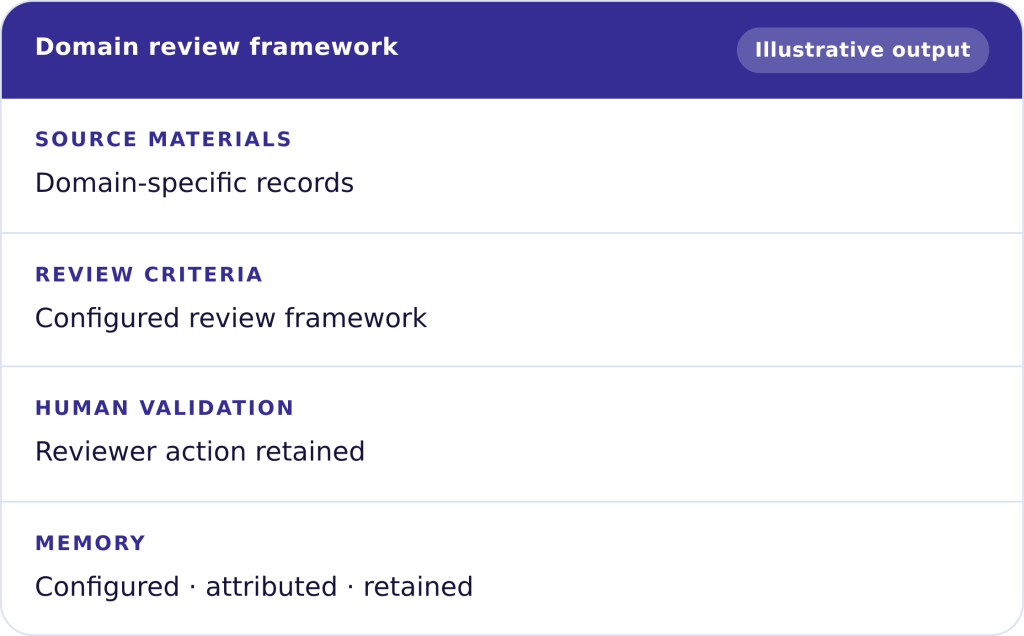
HOW THE DEFENSIBILITY BUILDS
Your domain-specific review logic, evidence patterns, decisions, and escalation history become a retained operating asset.
Identify one review environment where coverage gaps create exposure, and we will show what the system captures before full deployment.
