
image

Our genesis

Built by operators who experienced the problem firsthand.

Built by operators

DueDash began in private capital, not because it was the obvious starting point, but because it was the most demanding one. Investment decisions require evidence, accountability, and the ability to reconstruct exactly how a conclusion was reached, sometimes long after the people who made it have moved on.

The founders came from enterprise technology and capital allocation. They built and operated complex data systems at scale, and experienced firsthand how consequential review work disappears into scattered documents, emails, and individual memory the moment a decision is made.

Private capital became the proving ground not because it was the only market, but because it concentrated every dimension of the problem: document-heavy review, fragmented diligence, accountability to LPs, and the need to reconstruct decisions under pressure. The same characteristics appear in legal review, medical-legal work, compliance, and family office governance. The domain changes. The institutional memory problem does not.

DueDash was built to solve that problem at the infrastructure level. Not as a workflow tool. Not as an AI assistant. As the layer that preserves the record of how institutions operate, decide, and learn.

Our worldview

The problem is not AI. The problem is institutional memory.

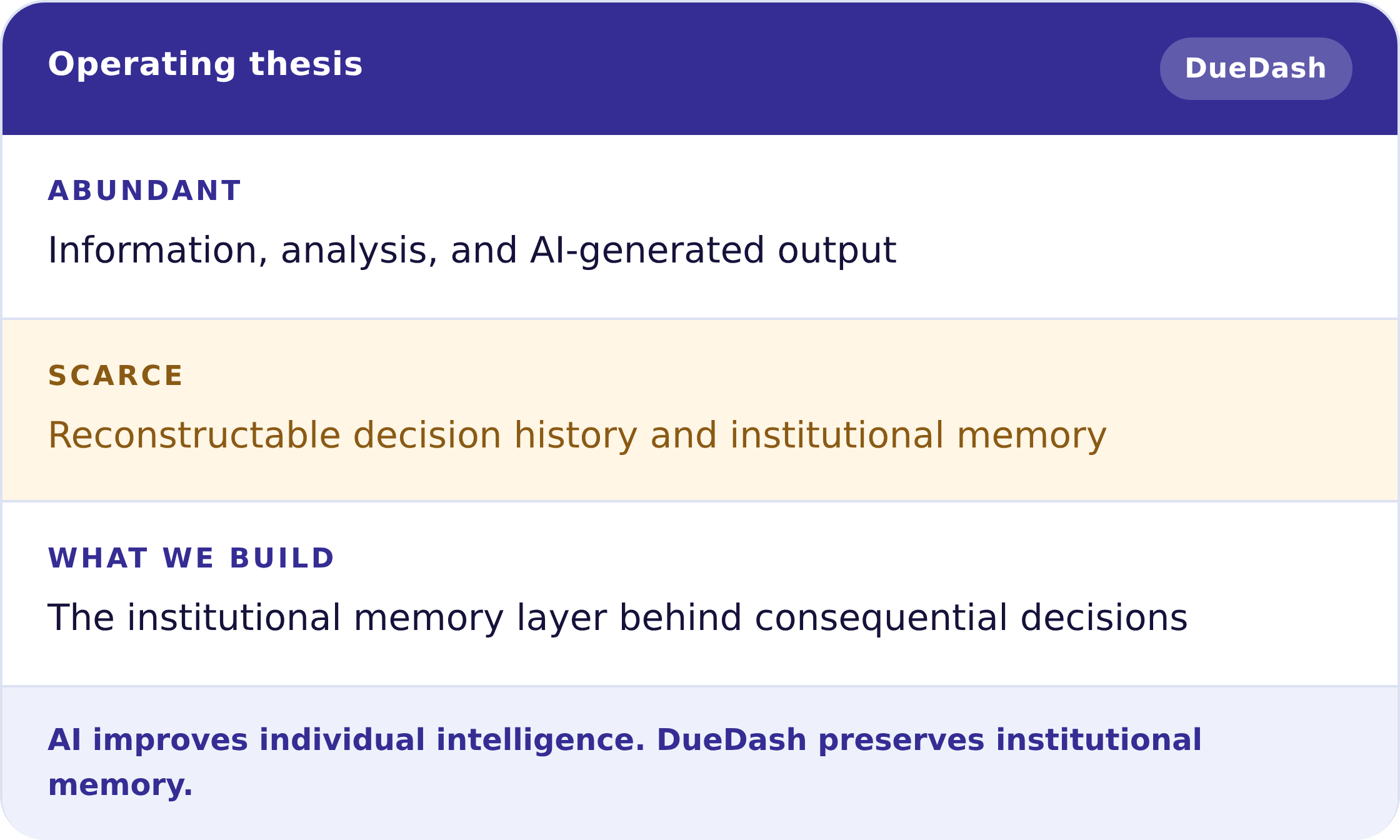
AI makes analysis easier to generate. It does not automatically make institutions better at operating, deciding, or learning. The scarce asset is the retained record of what was reviewed, what changed, who acted, why the decision was made, and what the institution learned. AI changes the volume and speed of work. Humans still carry accountability for what happens next.

Information is abundant.

Evidence continuity is abundant

Analysis is abundant.

Accountability is scarce.

Documents are retained.

Decision context is often lost.

AI generates outputs.

Institutions still need memory.

Models are accesible.

Decision history is proprietary.

Individual intelligence is increasing rapidly. Institutional memory does not automatically compound.

How we think

How we think about institutional review.

Modern institutions do not suffer from a lack of information. They suffer from fragmented review continuity.

Evidence, findings, decisions, and accountability become separated across systems, documents, and individuals. As information volume increases, reconstructing how a decision was reached becomes more difficult, not easier.

We believe institutions need infrastructure that preserves review continuity, not just information. The challenge is not producing more analysis. The challenge is retaining what matters after the analysis is complete.

DueDash exists to preserve that continuity.

What we believe

Three truths that drive DueDash.
1

Evidence first, always

AI-assisted review without source-linked evidence is just output. DueDash preserves what was reviewed, what was found, and where each finding came from.

2

Human accountability is non-negotiable

Institutional decisions still require accountable human judgment. DueDash records who reviewed, what was escalated, and why a decision was made.

3

Memory is the moat

The advantage is not the model. It is the retained history of how an institution reviews, challenges, escalates, decides, and learns over time.

Why we exist

The problem we saw.

Information is fragmented across more documents, systems, AI tools, and reviewers than traditional workflows were built to preserve. Review history is often lost. The final decision survives, but not the path of findings, escalations, and rationale behind it.

As AI adoption accelerates, more review activity occurs across personal chats, documents, and individual workflows. Institutions risk becoming more productive without becoming more coherent.

Decisions must later be reconstructed, sometimes long after the people who made them have moved on. That reconstruction should not depend on memory.

DueDash exists to turn review history into institutional memory and institutional memory into institutional defensibility.

Operating thesis

Operate. Decide. Learn.

Institutions do not only need more analysis. They need proof of what was reviewed, what changed, what was escalated, how decisions were made, and how the organization learned from them.

The more consequential work an institution reviews through DueDash, the more proprietary its retained decision memory becomes. That memory creates institutional defensibility competitors cannot copy.

The goal is not more automation. The goal is better institutional learning.

Founder conviction

Why this matters to us

Every institution we encountered had the same silent problem. Smart people were doing rigorous work, and then that work was disappearing, not because it was undocumented, but because the context behind it, the reasoning, the escalations, the decisions, the things that made it institutional knowledge rather than individual effort, was not being retained in any form the institution could use later.

We built DueDash because we believed that problem was solvable at the infrastructure level, and because it mattered more than most people were saying out loud. The organizations that retain how they think, review, and decide will compound that knowledge over time. The ones that do not will keep starting over.

How we built

Architectural principles.

Orchestration over replacement

DueDash works across the systems institutions already use. It does not replace systems of record, administrators, or professional judgment. It preserves the evidence and decision trail across them.

Evidence over summaries

Every finding connects to source material, reviewer action, and decision context. Generated output does not automatically become institutional evidence. Review comes before record.

Security by design

DueDash is built for environments where the evidence record is a critical institutional asset. Security protects the evidence record institutions build over time.

Human accountability

Institutional decisions remain attributable to accountable humans. AI assists review. Humans validate, escalate, approve, and decide. DueDash preserves that chain.

Institutional memory

Review history should survive people, systems, and time. The value of DueDash compounds as an institution retains more of how it operates, decides, and learns.

Customer-owned defensibility

We help customers build and retain their own evidence history. Each institution's review logic, escalation patterns, and decision memory remain proprietary to that institution.

Leadership

Built by capital operators and enterprise technologists.

DueDash was founded by operators who built and scaled enterprise data systems and worked inside capital markets. That combination shaped a product designed for environments where evidence, accountability, and decision reconstruction are not optional.

image

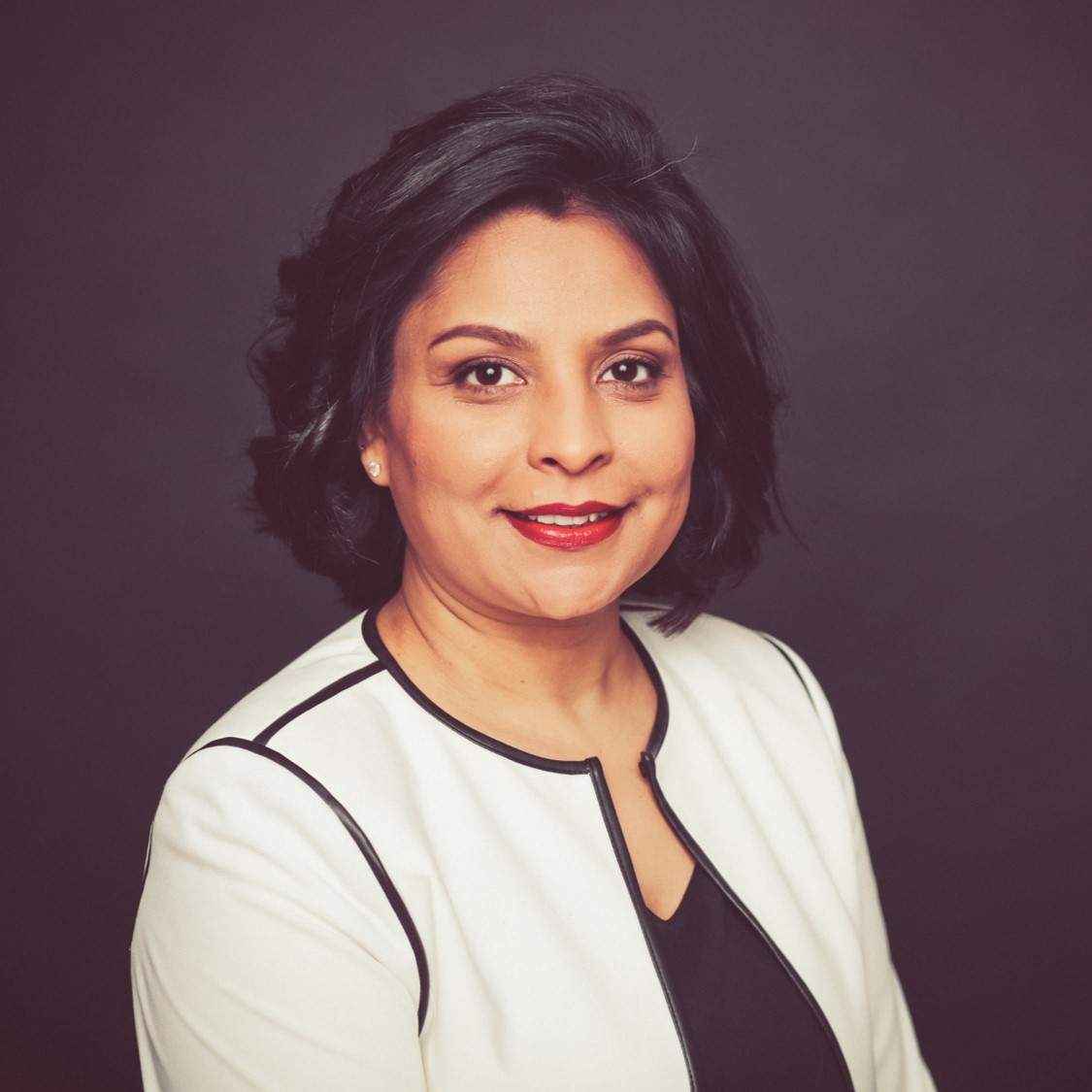
Parul Madan

Founder & CEO
Leads technical architecture, deployment execution, and platform security. Built and scaled enterprise-grade data systems before applying that experience to the institutional review problem.

image

Nikhil Madan

Co-Founder & COO
Operates at the intersection of capital networks, institutional workflows, and evidence infrastructure. Brings experience in capital allocation and the operational complexity of high-stakes review environments.
image

Michail Kosak

Co-Founder & CMO
Brings operational experience in enterprise technology sales, cross-cultural venture acceleration, and international market development. Previously worked with early-stage funds including Quake Capital and The Incubation Network to help structure data and commercial assets for institutional deployment.

Early Traction

Developed with institutions that understand the problem.

DueDash was developed through active deployment with design partners and pilot customers across private capital, IP review, and medical-legal environments.

Investor & Customer

Quake Capital

Design partner and investor. Engaged DueDash for deal-flow management, deal selection, and IC decision documentation in active private capital workflows.

Private Capital · Design Partner · Investor

First-Wave Partner

Deutsche Telekom

Early design partner in private capital. Engaged during the initial deployment phase to develop and validate the evidence architecture across deal-flow and investment decision workflows.

Private Capital · Design Partner

Pilot

PALQ IP

Pilot customer. A division of Saxton & Stump. Piloting DueDash across IP review workflows to preserve source attribution, reviewer lineage, and decision history.

IP Review · Pilot Customer

Medical-legal deployment in active use. Customer in stealth mode, available to discuss on a need-basis.

Additional deployments, pilots, and design partners available on request.

See how DueDash preserves the record behind high-stakes decisions.

Start with one workflow, one review environment, and one concrete proof point. The organizations that retain how they think, review, and decide will compound that knowledge over time.