

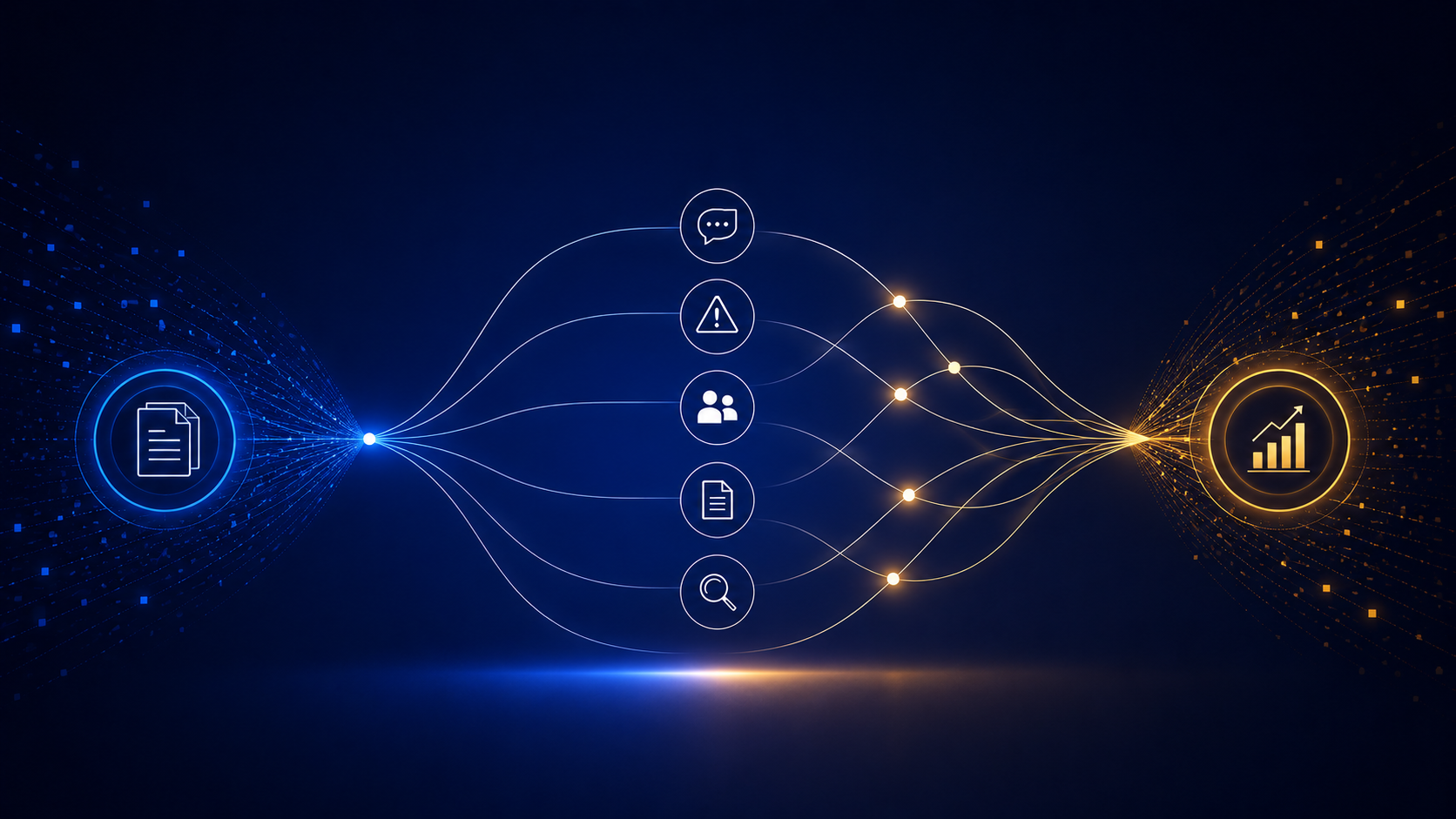
An investment committee approves a deal.
The memo is filed. The vote is recorded. The investment rationale is clear.
Eighteen months later, something changes.
Perhaps the portfolio company needs additional capital. A covenant needs to be amended. An LP asks about the original underwriting. Or a new partner wants to understand why the firm became comfortable with a risk that was visible at the time.
The decision itself isn’t difficult to find.
The memo survives.
The vote survives.
The final rationale survives.
What is harder to reconstruct is what happened before the decision.
What did the committee review?
What was challenged?
Which concerns changed the recommendation?
Which risks were ultimately accepted, and why?
Some of those answers may be in the IC memo.
Others may sit in comments, earlier drafts, emails, meeting notes, or simply in the memory of the people who were in the room.
And that creates a different institutional problem.
The IC process happened. But was the judgement behind it preserved?
That is the distinction between documenting an investment decision and preserving the review process that produced it. And it is becoming increasingly important to investment committee governance.
The Distinction
Investment committees are designed to preserve decisions.
They are not necessarily designed to preserve the judgement that produced them.
The decision record tells you what the institution decided.
The judgement record tells you how it got there.
What is IC Review Continuity?
The formal IC record tells you what the committee decided.
IC review continuity preserves something different: the material path to that decision.
A comprehensive IC memo remains essential. It captures the investment case and the formal rationale for the decision.
But the memo is a synthesis.
It documents the conclusion the committee reached. It may not preserve everything that happened before it: which materials were reviewed, how the recommendation evolved, which concerns were raised, and how those concerns were resolved before the vote.
That process — the governed path between analysis and approval — is what IC review continuity preserves.
The IC memo captures the conclusion. IC review continuity preserves how the institution reached it.
This distinction is easy to overlook when the investment is recent and everyone involved is still around.
It becomes harder to ignore when someone needs to reconstruct the decision later, particularly when the people who were in the room are no longer there to explain it.

What Survives and What Gets Lost
Most IC processes leave a strong formal record.
The memo survives. The vote survives. The financial model survives. The diligence materials survive.
What can be harder to reconstruct is the judgement between them.
Some of that path may exist across comments, emails, meeting notes and earlier versions of the deck.
The question is whether it exists as an institutional record — something a new partner, an LP, or an incoming principal could understand without asking the people who were in the room.
The gap may not be obvious while the investment is performing and the original team is still together.
It becomes more visible when the investment is under stress, the team has changed, or someone needs to understand not simply what was decided, but why the committee became comfortable making that decision.
AI adds another dimension because it can increase the amount of analysis sitting behind a recommendation.
But the underlying question remains the same:
Can the institution reconstruct how judgement shaped the final decision?
IC Record |
What Usually Survives |
What May Be Harder to Reconstruct |
|---|---|---|
IC memo |
Investment case and final rationale |
How the recommendation evolved |
Vote |
Decision, date, and approval |
Material deliberation before the decision |
Diligence |
Reports, models, and source materials |
Which findings changed the committee’s thinking |
Challenges |
Material issues reflected in the final record |
Who challenged what and how it was resolved |
AI-assisted analysis |
Outputs or findings that informed the review |
How outputs were reviewed, challenged, or changed |
Risk acceptance |
Final risk position |
Why the committee became comfortable accepting the risk |
Five questions to assess your IC review continuity
The table above shows what typically survives and what may be harder to reconstruct. These questions test whether the same gap exists in your firm.
1. What was reviewed?
For your three most recent IC approvals, can you reconstruct the material analysis the committee reviewed before approving the investment — not simply locate the final IC memo?
2. How was AI-assisted analysis reviewed?
If AI-generated analysis informed the recommendation, can you show how it was reviewed and validated before the IC decision?
3. What was challenged?
Can you identify which material concerns were raised, who raised them, and how they were addressed before the vote?
4. What changed?
Can you reconstruct how the recommendation evolved from the initial analysis to the final committee position?
5. Would the reasoning survive the people?
If an experienced IC member left the firm tomorrow, could another investment professional reconstruct the reasoning behind recent decisions from the institutional record alone?
If answering any of these requires searching emails, piecing together partial records, or asking someone to remember what happened, you have found the gap.
What the Evidence Shows
Institutional LP diligence already goes beyond performance and track record.
ILPA’s Due Diligence Questionnaire asks managers to describe their internal decision-making and approval process, including the role, composition and function of the Investment Committee. Its broader guidance also places governance and transparency at the centre of the GP-LP relationship.
That does not mean LPs are explicitly asking for something called IC review continuity.
But it does point to a broader governance question for managers: can the firm explain how investment decisions are made, not simply identify who made them?
And that leads to a harder question.
If someone wanted to understand how a particular investment decision was reached, what could the institution actually reconstruct?
The IC memo may explain the final investment case.
The vote may establish the decision.
But neither necessarily preserves the full path of review, challenge, and change that produced it.
That is the gap IC review continuity is intended to address.
Why AI in Pre-IC Review Makes This More Important
AI is increasing what happens before the Investment Committee ever meets.
Investment teams can review more documents, extract more information, surface more risks, and compare more findings, faster.
That’s useful.
But it also means more analysis can sit behind a single IC recommendation.
Imagine AI surfaces twenty findings.
The investment team decides eight matter. Three are challenged. Two change after additional evidence. One materially affects the recommendation.
What reaches the IC may still be a polished investment memo.
Come back two years later, and the question is whether the institution can still reconstruct that evolution: which findings mattered, which were rejected, what changed after human scrutiny, and what ultimately affected the decision.
The issue isn’t whether AI was involved.
The issue is whether the record of judgement scales alongside the analysis.
As AI increases what investment teams can examine, there is more human judgement worth preserving, not less.
Can the institution show how analysis became judgement, and how that judgement became a decision?

Three things to do before your next IC
1. Test the Record
Start with your three most recent IC approvals and try to reconstruct how each decision developed using the institutional record alone. Resist the temptation to ask the original deal team to fill in what is missing.
If the reasoning can only be recovered through individual memory, that tells you where the institutional record ends and personal knowledge begins.
2. Separate the Decision from the Judgement
The IC memo, vote, and final rationale preserve the formal decision, but they serve a different purpose from the record of judgement that shaped it.
A mature institutional process should preserve both: the decision itself and enough of the reasoning behind it for someone else to understand how the institution reached that position.
3. Capture the Record While the Decision Is Being Made
The objective is not to create another administrative exercise after every IC meeting. It is to preserve material reasoning as part of the investment process, while keeping the context current and ensuring the people involved still understand why particular choices were made.
Months or years later, the documents may still be there, but the context around them can be much harder to recover.
Preserve the judgement while it is being exercised, not when someone later asks for it.
Frequently Asked Questions
What should an Investment Committee record?
The formal record typically includes the IC memo, the decision, relevant materials, and the rationale.
But firms should also consider whether someone can later reconstruct the material review behind the decision: the significant challenges, changes and risk considerations that shaped the committee’s final position.
What is IC review continuity?
IC review continuity describes the preserved record of the material review behind an investment decision: what was reviewed, what was challenged, what changed, and how those factors shaped the final recommendation.
It connects the formal IC decision to the judgement that produced it.
How does AI affect Investment Committee governance?
AI can increase the amount of analysis available before an IC decision. That creates a practical question: if AI-assisted findings materially influence an investment recommendation, can the institution later understand how those findings were reviewed, challenged, and incorporated into the decision?
The issue is not simply preserving AI output.
It is preserving the human judgement applied to that output.
Is this the same as recording every IC discussion?
No. The objective isn’t to create a transcript of every conversation, comment, or disagreement.
It is to preserve the material review that shaped the decision: the issues that mattered, the changes that followed, and why the institution ultimately became comfortable proceeding.
Why does this matter to LPs?
An LP evaluating a manager may want to understand not only what investments a firm made, but how material investment decisions are governed.
A reconstructable decision process can provide a clearer picture of how the manager reviews risk, challenges assumptions, and reaches investment decisions.
The DueDash Distinction
DueDash preserves the Institutional Evidence around investment decisions: what was reviewed, who reviewed it, what changed, what was challenged, and how the investment recommendation evolved before approval.
The objective isn't more IC documentation.
It's making sure the judgement behind the decision doesn't disappear.
